Tuesday, June 14, 2011

Don't Drink That Water!!!

I'm sure everyone remembers the powerful earthquake that struck Haiti in 2010. The 7.0 magnitude earthquake ravaged the Haitian landscape leaving cities and people in ruin. Beside the obvious destruction the earthquake produced it also brought about serious health risks. I remember watching the news and seeing these families in tent cities. Anderson Cooper, of course, interviewing the people and giving the world a view of unimaginable poverty (his infamous black shirt is depicted right being given a medal for spreading fear). At the same time I thought, "these people are going to get sick. It may not happen today, or tomorrow, but at some point an outbreak of something will occur." In December 2010 an outbreak of cholera began, marking the beginning of the one of the worst cholera epidemics in modern times.

The story of cholera has its origins way back in history. Like many other illnesses, people in the 19th century knew the disease cholera. In fact it was the first reportable disease in U.S. history. In 1854, the world changed with the use of keen observation. Throughout history, diseases like the plague were thought to have two sources. One was God and the other was the miasma theory. The first being that God punishes humanity by means of disease and the second being that the deadly fumes from swamps and the dead bring about disease. A English physician named John Snow was skeptical to the miasma theory of disease and being the good physician he was decided to investigate the clusters of cholera outbreaks in England.  He used a map and plotted the locations are those infected. Then he placed this map over a map showing the drinking water system throughout London. He saw that every infected area drew its water from a single well. After debate with authorities, Snow finally got them to close the well and like magic the incidence of cholera dropped. It's because of this simple observation that Snow became the father of epidemiology, a path that I would like to follow some day myself.
From the observation that sewage contaminated water was the source of disease, Robert Koch (the man! see the first post. He's the one with the sweet beard!) used his own methods to show that cholera was in fact caused by a bacteria. Just like anthrax, cholera was not transmitted by a miasma but a bacillus that named vibrio cholerae. Together Snow and Koch developed the fundamentals of bacteriology and epidemiology: Infectious diseases are caused by bacteria and each one was a particular route of infection.


If yersinia pestis is the Black Death then vibrio cholerae is surely the White Death. The reason is simple enough, it causes a sever diarrhea that is white. Yes I'll say that again it's white, like rice water, hence the condition called Rice Water stool. It doesn't have a smell nor a color. Essentially it's just water that is leaving the body. If left untreated it will probably kill the host. This is why many cartoons were made in the early 20th century that portray cholera as Death or Death spreading cholera. I love the top of that picture the most, it made me laugh.

The pathogenesis of vibrio cholerae begins with its two plasmids. These plasmids contain two pathogenicity islands (clusters of genes coding for virulence traits) coding for the toxin and an adhesin respectively. Interestingly, the clusters of genes coding for the toxin are now believed to have been derived from a bacteriophage that injected its genes into a harmless virbio. The bacteria is initially ingested and then adheres to the epithelial lining of the intestinal tract. This is why it has the adhesins. The next thing that occurs is the secretion of the cholera toxin.
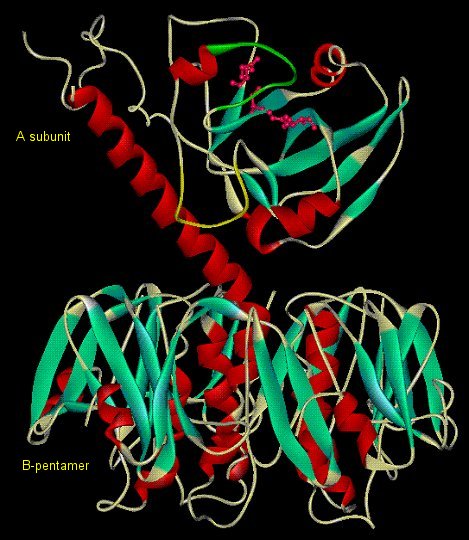
So, vibrio cholerae secretes the toxin into the environment. This toxin has a ton of individual components but can be broken down into two main parts. The first is the receptor binding domain (B domain), which is a series of five peptide subunits that act together for the toxin to bind to the GM1 ganglioside on the surface of the intestinal epithelial cell. I know, I know...a ganglio-wha? It's essentially a sugar molecule that extends off the host which it uses for signalling with other cells. Anyway, once it binds the GM1 ganglioside the cell takes the toxin up via endocytosis like it would to anything else that gets bound. Inside the vesicle, the receptor binding domain releases from the catalytic domain (A domain), the part of the toxin that ends up doing the damage. The A domain passes through the B domain which releases the A part into the cellular cytoplasm. The picture to the left shows the cholera toxin with the B domain on the bottom and the A domain on the top.

Now the story get's cool. If you read the e. coli post this'll sound familiar. So, the toxic A domain ADP-ribosylates a G protein on the inside surface of the cell membrane. By adding this small molecule the G protein can no longer regulate the enzyme adenylate cyclase by turning it off. The result is that this enzyme stays on, and makes a large amount of the molecule cAMP. This molecule acts on ion channels causing ions within the cell like K+, Ca 2+, and Na+ to leave the cell. Due to osmotic force, water inevitably follows and leaves the cells. The water goes into the intestinal lumen and this is the source of the "rice water stool" seen left. Not pretty...

The result of this drop in water volume leads to hypovolemic shock which leads to kidney failure and death. It's for this reason that physicians use a series of ions including sugar as treatment. Interestingly, the sugar channels are not effected by the toxin, so by bringing sugar into the cell water will follow and flow back into the cell hopefully stopping the watery diarrhea. Super clever! We can use osmolarity against the disease which is ruled by osmolarity! What's important is that they replace the amount of water that is lost. In order to do this clinics use the so called "cholera cot." It's a cot with a hole in it with a bucket that measures the amount of water that is expelled from the body. Very simple but super effective!

Cholera remains as a disease exacerbated by poverty. Indeed cholera is a disease not commonly found in the modern world, but runs rampant through underdeveloped nations where human waste contaminates the drinking water. Luckily, it's an easily treatable disease and if treatment is given promptly and effectively it should be cleared on its own. Antibiotics are usually not prescribed unless it is severe. 

Vibrio cholerae has played a serious role in history effectively shaping how epidemiologist started to understand how bacterial diseases are spread. Importantly, in modern times Horizontal Gene Transfer has resulted in the transfer of the cholera toxin to previously avirulent types of bacteria like e. coli. Likewise, this same process resulted in vibrio's acquisition of the toxic genes in the first place! In the wondrous world of biology we have to appreciate how these bacteria evolve so quickly. We also have to recognize that in order to address the spread of these diseases we need to help nations with simple necessities like clean drinking water. 


Saturday, June 11, 2011

So You Have A Virus...Some Antibiotic Should Clear That Right Up

I was watching the news tonight and was taken aback by a very small phrase. As we are all well aware, the Center for Disease Control and Prevention (the CDC, the holy grail of work places for me) has been tracking the course of deadly e. coli that has recently surfaced in the U.S. The news was covering this story when the anchorman said "This virus..." I cringed.  He had implied the e. coli, a bacteria, was a virus. This is the sin amongst all sins in the microbiology world. Thinking about it I realized that many people see the terms "bacteria" and "virus" as interchangeable. More importantly, this habit would lead one to believe that they are the same. This post intends to draw a clear distinction between a bacteria and virus and examine how evolution had played a role in the persistence of each.


I'll begin with the virus. Let's take a trip back to the beginning of life. I'm not talking about primitive amoeba, I'm taking further back than that. The story of the virus may well begin at the beginning of life itself. At some point in time a layer of fat was able to surround a randomly attached molecule of base pairs. Thanks to Carl Woese (UI ftw!) it is now plausible to believe that this molecule was RNA as it is much more primitive than our double stranded DNA, hence what he called the RNA World.We'll skip a few million years until this thing ("life" sounds like a stretch for a fat covered bubble) somehow gained the ability to replicate its own genetic component. This is another piece of evidence for the RNA World because RNA can use itself as a mechanism to replicate its own sequence. Anyway, at some point the RNA in this thing somehow left its original sequence by an unknown cause (if you thought transposon, the jumping gene from a previous post, then you deserve a cookie). More importantly this RNA could no longer be replicated unless it is within its parent. This rouge RNA, by the laws of physics, buds off the thing and the result is a separate fat covered bubble that now has a bit of RNA that can be replicated only when its back inside of the host. This is a very murky description of the creation of the primitive virus. In case you're wondering, "The Thing" in John Carpenter's horror movie replicated and disguised itself much live a virus in nature, hence my word choice.


Protein Capsid of Herpes Simplex Virus-A which
 houses the genome of the virus
Note that for viruses I used the word "persist" and not "survive." "Survive" implies that viruses are a living organisms. This is not the case for several reasons. They do not replicate on their own. That's a biggie. The other big one is that they do not produce their own energy. A lot of scientists disagree and do consider viruses to be alive, but by the biological definition they are in their own grey area of existence.

Viruses can come in many flavors which are based on the genetic material they have. They can be single stranded (ss) RNA, double stranded (ds) DNA, ssDNA, and dsRNA. Interestingly, viruses are the only things on Earth that have dsRNA and your cells have evolved a receptor that specifically bind this molecule. If dsRNA gets bound the cell knows its being attacked by something really foreign and really bad, so it usually kills itself right away to prevent viral replication. Sorry, I get so excited about viruses that I can get sidetracked! They can also have a lipid envelope or they could be "naked" and only have a protein capsid that holds the genome inside.

Evolution has done something pretty crazy with these guys. They pack their genomes full of genes in extraordinary ways. Unlike us, viruses can have multiple coding regions of genetic material that overlap with each other. Basically, by starting the process of translation in a different spot, they can make fully functional proteins. If we tried that we'd end up with junk! For instance take the phrase "The Fat Cat Ate The Rat." All three letter words that make a perfect little message we can all understand. Let's say hypothetically instead of started at the first T you start at the H instead. Try reading it in the same sequence of three letters...of course you can't because it doesn't make any sense. But in the viral world such a message would make perfect sense. Because of this phenomenon, viral genomes are can be very small but pack a ton of different genes. Pretty cool, huh?

Now for bacteria. Unlike viruses, bacteria are alive. They replicate on their own and they produce their own energy through super fun metabolic pathways that become not so fun when you're taking a biochemistry class. Bacteria are far more complex than a virus, with genomes that are much larger and produce many more different kinds of proteins. In order of complexity the progression is virus << bacteria< eukaryote. That being said, bacteria were probably the first complex forms of life on Earth. And as long as they've been around, a virus has been around to infect and replicate inside. So as history progressed and cells became more specialized, the virus also had to adapt in order to be able to infect these new kinds of cells.

This is the bare bones of it. I'll do a much more expansive examination of viruses later because I realized I have a lot to say about them because they are super primitive but can do things that make the heads of scientists explode. The point to all of this is that bacteria and viruses are not the same. So if you have a bacterial infection, antibiotics will hopefully take care of the problem. However if a doctor prescribes antibiotics to you after diagnosing you with a virus, you are wasting your time because you can't kill what isn't alive.

Tuesday, June 7, 2011

The Plague of Our Generation


My generation has seen a couple of pandemics and pandemic scares. From H5N1 influenza (the dreaded bird flu which never came to fruition) to H1N1 (the swine flu which did spread across the world) and from SARS to anthrax the media has time and again presented the danger that these agents have on world health. But truth be told none of these have had the impact from both a social and medical perspective than has the HIV pandemic. This year marks the 30th anniversary of the first reported instances of HIV in the US and I thought I would take a little time to remind everyone what this virus has done not only to those infected but how it has also been a pandemic with great social implications.

The story of HIV and AIDS begins fifty years ago in Africa. This virus has great similarity to a similar virus called the Simian Immunodeficiency Virus and it is widely agreed that fifty years ago, a virus similar enough to SIV evolved the ability to infect humans. Thus, some poor human in Africa came in contact with simian blood and with it came a new virus that would begin the worst pandemic in human history. Twenty years later on June 5th, 1981 doctors in the US started to note something very strange. In LA there were five patients with a peculiar case of pneumonia caused by a bacteria that wouldn't normally infect a human with a healthy immune system. Immune titers from these patients confirmed that all of those with the pneumonia had a severely compromised immune system, with white blood cell counts as low as 200 per uL, only 14% of what a normal count should be.

freddy mercury, fredy mercuri, fred mercuri, freddi mercuryAs media spread coverage of this strange new virus one thing started to stand out amongst the patients infected: they were gay. Not knowing what this new disease was it gained the name GRID, gay-realted immune deficiency, however later it became clear that the virus didn't only effect the homosexual population and the name was changed again. Still, the gay population became stigmatized for harboring this virus and the true face of HIV emerged. Freddy Mercury, the singer of Queen, literally took the knowledge of his infection to his death bed in 1991. Even today, thanks to the media, HIV infection has become synonymous with homosexuality, drug use, and sexual misconduct the end result of of which is invariably the contraction of HIV.


In the 80's the infection also became a death sentence. With no treatment available for this disease those infected could only wait until they became infected with a normally harmless bacteria and the body was overrun. Because of this, partners would leave each other once HIV was diagnosed seeing it as a mark of imminent demise given from the person they loved. Luckily, miracle drugs emerged that could prolong the life-span of the infected for years and years and HIV. Now, HIV is no longer a death sentence and has turned into something more of a chronic illness.

The human immunodeficiency virus  infects CD 4+ T cells, also called T helper cells. These cells are charged with the responsibility of helping clear foreign agents from the blood. The virus binds to the cell and fuses its membrane with the host cells, causing the virus to release a protein capsid into the cell's cytoplasm. The capsid falls apart and releases the true monster into the cell, it's RNA. The RNA genome is reverse trasncribed by a unique enzyme called reverse transcriptase and becomes DNA. Worse, the DNA is taken to the host genome and another enzyme called integrase inserts the genome into the host cell's. As the cell replicates, it unknowingly produces more virus particle by the constant replication of the host genome which now houses the virus's genome too.


The wonder drugs target reverse trasncriptase prevent the production of DNA, and thus any step that comes after. The identification of this enzyme proved a leap forward in the field of biology. The central dogma has always been DNA--> RNA --> Protein. That's the way life works. It's the schema that makes you you and makes me me. From skin to hair, every organism on Earth is under the influence of this genetic process. This is why when researchers said they found an enzyme that makes RNA into DNA (RNA --> DNA) the scientific community scoffed at it, unable to believe that the central dogma which rules all of biology at the level of the gene could possibly be broken. However, the scientists prevailed and would be rewarded with the Nobel Prize.

This enzyme also proves the be the necessary driving force behind the evolution of the virus. The problem is that reverse transcriptase does not have a proofreading mechanism like the DNA polymerases in your cells. In humans, mutations in DNA are bad so the machines that make DNA have methods of checking their work and fixing mistakes. But, in microbes eliminating this mechanism can proove beneficial. Since the replication rate of microbes is so much more frequent than any other organism, if you eliminate the proof-reading, you can potentially cause mutations that allow the pathogen to produce functional proteins but with slightly altered attributes. This could mean the ability to bind a different receptor or in the case of HIV, the evasion of drugs. This is why new drugs are constantly developed for HIV. Reverse Transcriptase can mutate the genome and prevent it from being recognized by the drugs.

Today in the US, the infection rate of HIV is down thanks to the scientific understanding of the virus and education of students about sexual health. However, we cannot hope to solve the pandemic unless we help those that truly need help. No region needs more than the countries in Sub-Saharan Africa which show higher rates if infection than any other region. It's up to the WHO to develop a plan to deliver the aid and drugs necessary to help. Not only that but we need education in the region too. South Africa employs a HIV positive Sesame Street character named Kami in order to achieve this end. Even here though there is a great divide between the rich and poor. 80% of the citizens in South Africa receive treatment from public clinics which are understaffed and not equipped to help all those in need. In a region that is skeptical about the actions of western culture, we must also be mindful of how we would instigate such an intervention.


Although we have the medical means necessary to fight the disease what it really comes down to is money. Poor people and poor countries cannot afford the drugs, a point satirized in South Park where the cure to HIV is "concentrated cash." Also, drug users that don't have access to clean needles are also at risk of contracting HIV and other blood-bourne pathogens. There needs to be an investment in the research for a vaccine to the virus as well as preventative care not only here in the U.S. but worldwide. It's only with this amount of cooperation that we can ever hope of nearing a day where the infection rate and mortality rate of HIV is 0.

Friday, June 3, 2011

When Bacteria Get It On

I've alluded to this phenomenon in the previous blog post about e. coli (check it out b/c it's awesome, like everything I write). It is known as Horizontal Gene Transfer, or HGT for short. There are four processes that are included in HGT which are conjugation, transduction, transposons and plasmids, and transformation. In the world of pathogens this is the way that new traits are obtained quickly and efficiently between organisms and it is probably the most important principle in the quick evolution of pathogens. This exponentially increases the genetic variation within the species of bacteria and produces bacteria with brand new phenotypes we've never seen before.

Let's start with conjugation. Enter Marvin Gaye because they are about to get it on! Ok so bacterial sex may be a bit of an exaggeration but it's easy to see why the process of conjugation has become perceived in this way. In this process a bacteria that contains the "sex pilus," a series of proteins on the bacteria membrane, extends and makes contact with a neighboring bacteria. The pilus can then contract which draws the bacteria closer together and finally, their membranes make contact. Now, essentially their is a direct link between the bacteria called a conjugation bridge. This allows easy passage of genetic material from the donor cell to the recipient and the recipient cell now contains whatever genes were sent through the conjugation bridge.


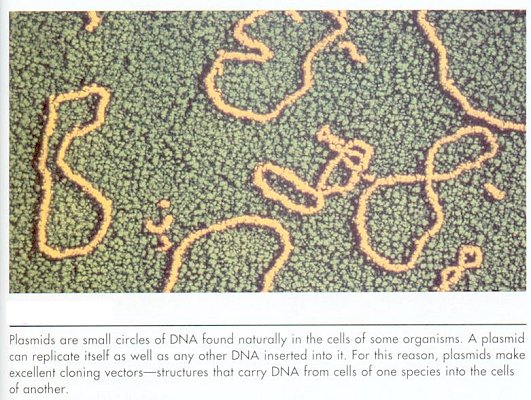
Plasmids and transposons are transmittable genetic elements that can be transferred through conjugation and really any other process in HGT. Plasmids are uber important...seriously, plasmids run the show in terms of bacterial evolution. These are small, circular bits of DNA that is now contained within the genome of a bacteria. These plasmids usually have genes that allow bacteria to survive in a different niche. Antibiotic resistance is usually conferred to bacteria via plasmids. More importantly, these plasmids are highly stable and easily transferred through the conjugation bridge. The end result is that both bacteria end up with the plasmid! BOOM!


Transposons are like Rick James...super freaky. These things are small bits of DNA that can actually "jump" out of a genome! Yep that's right, these little guys jump out of one bacteria's genome and can recombine into another's, bringing whatever genes it carries along with it. Again, conjugation allows easy transfer through the conjugation bridge. Transposons are pretty nuts and I don't even know the entire details of how these things work, but they are very important in bacterial evolution. In fact, a ton of the human genome has been found to be derived from transposons!


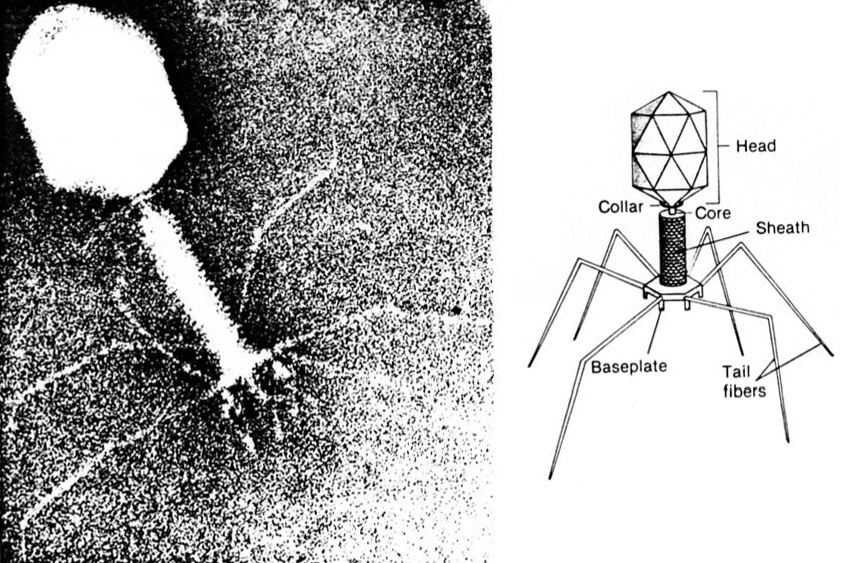
The next method of Horizontal Gene Transfer is transduction. This is the injection of genetic material into a bacteria via a bacteriophage. Those are those weird alien looking things that you've probably seen somewhere before labeled "virus." Yes, those are viruses but they only infect bacteria which is why when you see them in movies infecting humans, it's wrong! After injecting the genetic material into the cell, it can recombine within the genome of the bacteria and it now has whatever genes it gets from the bacteriophage. The shiga toxin from e.coli is one of many genes controlling toxin production that is believed to have entered the bacteria via this method.


Transformation is the last form of HGT. Here, a bacteria becomes "competent," or able to take up extracellular genetic material. What happens here is that bacteria that have holes in their membranes are able to take up genetic material from outside of the cell and then recombine it into their genome to obtain the traits. The DNA is obtained after cells die and rupture, releasing it's genetic material to surrounding cells. It's important to understand however that not all bacteria are able to do this naturally. Labs take advantage of an electric shock to make cells competent so they can insert whatever plasmids or other DNA they want to insert into bacteria. Some bacteria are naturally competent, like neisseria gonorrhoeae (last time I'm spelling that), and can take up DNA if it's available.

Click to see an enlarged picture
Through these methods, bacteria can obtain a wide variety of genes very quickly. Instead of waiting millions of years for evolution to produce better mechanisms of survival, bacteria can obtain new genes and immediately express new phenotypes without having to wait. This has been a scourge to the medical field due to the increase in antibiotic resistance in bacteria seen in hospitals. What's awesome here is that genes can cross genus and species lines from bacteria to bacteria, an impossible feat for humans. Imagine how awesome it would be to be able to exchange DNA with tigers, wolves, or birds and be able to recombine and express those genes! People could have bird wings, tiger strips, and wolf fur!

Monday, May 30, 2011

The Man of Many Hats

I was thinking about pathogens for a new blog post while biting into a delicious, 100% angus beef burger the other day and thought about the kinds of organisms that could be hiding within. Of course the chances are remote but I thought about infections of Escherichia Coli...that's the last time I'm going to try spelling that word! As a result, I decided to post a little bit about this bacteria. Crazy enough, I read on the news today that 14 people have died and hundred are sick in Germany and across Europe due to contaminated cucumbers so this post fits perfectly with a current event.


What few recognize is that e.coli isn't this horrible pathogen that inflicts disease whenever you have it within your gut. In fact, everyone has billions of these organisms sitting in their colon right now and they're definitely NOT making anyone sick. More importantly these bacteria are supposed to be there to help digestion by breaking down cellulose from plants that humans eat. Humans can't digest this material (aptly named "insoluble fiber" on the nutrition facts on the product label) so the bacteria that are harbored in your gut are beneficial to you. Disturbing this balance can increase the risk of other types on conditions, but I'll save those for another post.

So what gives e.coli such a bad rap? The answer to that starts with an incident that happened in 1982 with a restaurant food chain. The hamburgers that were served harbored a dangerous strain of e.coli that was ingested by customers leading to deadly gastrointestinal problems combined with kidney failure. Some of those infected died and e.coli suddenly became a bacteria to be feared. Isn't the media a wonderful thing?

Ok, great, so what made that bacteria so deadly compared to the ones in your gut right now? The best way to answer this is seen in the 6, yes that's right 6, kinds of pathogenic e.coli. I'll only explain 4 of them because little is known about the last two and these four and are the primary cause of disease in humans. The difference, the presence or absence of various virulence factors that mediate disease.

The first in Enterotoxigenic e.coli or ETEC (E-teck). This causes what many call "Traveler's Diarrhea" or, if you're in Mexico, "Monteczuma's Revenge." It's the leading cause of bacterial diarrhea in developing countries as well due to contamination of drinking water with run-off from waste. This form of e.coli has acquired two virulence factors from horizontal gene transfer, a nifty trick that also deserves its own post. At some point in the bacteria's evolution, it acquired the genes coding for two toxins called the heat-labile toxin (LT seen below with fancy colors) and the heat-stable toxin (ST). The LT acts very similarly to the cholera toxin providing further evidence for an acquired virulence factor from a different bacteria. The LT functions by adding a ADP-ribose molecule (right), which is modified from NAD (the top part of the molecule on the right) used in normal cellular metabolism, to a special kind of protein within the host cell membrane called a G protein. These G proteins functions to regulate other proteins in the membrane that further act upon ion channels using a molecule called cAMP. What happens here is that the addition of this ADP-ribose molecule causes the G Protein to become constantly activated. This eventually deregulates the ion channels by having way too much cAMP around, which leads to more salt ions in the intestinal lumen of the host organism. In order to balance the increase in salt, water flows out of the cell and into the intestinal lumen which leads to diarrhea...super fun! The ST works in a similar manner but instead of an increase in cAMP, there is an increase in cGMP but the result is the same.

The next is the one that has caused the raucous. It's known as Enterohemorragic e.coli or EHEC. The model system for these strains is e.coli O157:H7 and this is the same bacteria isolated from the patients that ate at the food chain in 1982. Here again, the culprit is the aquisition of a virulence factor from a different bacteria. In this case the bacteria acquired the Shiga toxin (left)  from a closely related bacterial pathogen called shigella. What separates this from ETEC is the fact that EHEC actually kills the intestinal cells they infect. The shiga toxin cleaves 28s RNA (what the hell is that!?).  28sRNA is a necessary part of a ribosome which translates proteins from the mRNA the cell makes from DNA. Another rule in biology : If you (the cell) can't make protein, you (the cell) die! So by getting rid of 28sRNA the cell not longer produces proteins and dies which leads to the destruction of the instestinal tract and the bloody diarrhea found in these patients. It is also associated with a condition called hemolytic uremic syndrome wherein blood cells are destroyed leading to acute kidney failure which is very bad.


The third form of e.coli is Enteropathogenic or EPEC. This strain is super cool. Intestinal cells don't have the necessary receptor to mediate proper attachment of the bacteria. This isn't good for the bacteria so it cleverly has a gene that codes for the its own receptor called TIR. The bacteria then uses a syringe-like molecular machine that injects the receptor directly into the host cell! The receptor then migrates to the membrane and, shazam, the bacteria can now attach to the cell to mediate disease via the intimin protein on the bacterial membrane. Disease is caused by the syringe-like machine injecting other proteins that mess with the host cell membrane, specifically by forming a pedestal on which the bacteria sits (left)...sounds weird but it's true and it's awesome! By screwing with the cell membrane, the intestinal tract loses the tightly bound and organized structure formed by these cells and the result is poor absorption of water leading to diarrhea...super fun!

The final strain is Uropathogenic or UPEC. This strain of bacteria caused urinary tract infection! Here the e.coli has acquired a different set of factors. They have the P pilus which is a protein that is designed to specifically bind to bladder and urethral cells. The result is that these bacteria can ascend the urinary tract and, if given the chance, infect the bladder or even the kidneys. These infections are fought off by the induction of the inflammatory response of the body, and the result is the burning and pain associated with a UTI. Interestingly, this strain has developed a unique way of preventing being eaten by the body's macrophages. The bacteria elongate outward (pic right) and the macrophages can no longer extend enough to take them up! Evolultion ftw! The problem comes when these bacteria infect the kidneys, a condition called pyelonephritis. Inflammation here is very bad!


Wonderful, so what's the point here? Well, first, e. coli is awesome in its diversity. But more importantly, these are the same bacteria which differ only in the set of virulence factors they contain. Not having any factors means the bacteria can't do anything and is harmless. But thanks to horizontal gene transfer between bacteria, e.coli has developed novel ways of causing disease in humans. Increasing the diversity within the e.coli population is evolutionarily beneficial to the bacteria because it allows the bacteria to infect and survive in a different niche within the host, as best shown in UPEC which infects the urinary tract instead of the GI tract. Also, in the case of enteric e.coli (ones that infect the GI tract) diarrhea can also be seen as a potential benefit because it increases the chance of the host organism shedding the bacteria into the environment and allowing uptake by other organisms by the fecal-oral route...gross, but more common than you think!


The moral of the story is simple. The variation of diseases caused by bacteria are caused by the acquisition of virulence factors which can turn a previously avirulent strain of bacteria into a potentially deadly one. It's important to understand this principle if the influence of evolution on a pathogen is to be understood. As you will soon see, bacteria develop ways of swapping bits of genetic information in order to increase fitness and the result is new strains of pathogenic bacteria that were once harmless.

Friday, May 27, 2011

Wool, Soil, and Mail...Er, What Do They Have In Common?

Something funny happened to me last week that I found as inspiration for my first pathogen article. I forgot completely that four years ago at the end of my senior year of high school, I wrote a letter to myself to be delivered four years later. I received the letter and read it and laughed at how naive I was at that age. What was more surprising was that I received another letter in handwriting that was not my own. I opened it in curiosity and there was simply one word haphazardly written in the middle of a piece of torn out notebook paper. It read "Anthrax." Of course, based on the friends I hung out with, I assumed it was both referring not only to my aberrantly high affection towards bacteria even at that age but the 80's metal band of the same name. When I read this I smiled and gave a laugh. I don't think whichever of my friends sent me that letter in high school had any idea that in four years I would be so amused upon receiving it. It was my final graduation gift, a happy farewell from four years ago and another happy farewell to my undergraduate career four years later. 

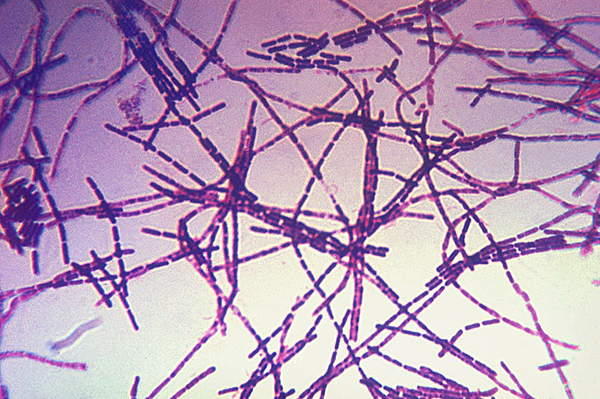
This got me thinking about everything I had learned about bacillus anthracis, the causative agent of anthrax. Of course, anthrax gained national attention during 2001 when several letters filled with b. anthracis spores were sent to several high profile people including Tom Brokaw. But the history of bacillus anthracis (that's pronounced anth-ray-cis) goes back far before these incidences. Robert Koch, the father of bacteriology, used b. anthracis in 1877 to show that bacteria cause diseases. This was the first time that the bacterial basis for disease had ever been proven beyond a doubt and it became the fundamentals of Koch's Postulates which are still used today as a means of determining if a pathogen is the causative agent of a disease. Basically, he's the man AND he has a pretty sweet beard.

Interestingly anthrax was primarily a disease in people who sorted wool. Animals would become infected with the bacteria after picking it up from the soil where it normally resides in the environment. Humans would become infected as a result of close contact with the infected animal. The disease became known as Woolsorter's Disease and it proved to be rather fatal. 

There are three forms of the disease which depend on where contact with the bacteria is made. This includes cutaneous anthrax (located on the skin as black, necrotic lesions...gross), gastrointesinal (in the stomach after ingesting spores), and pulmonary (inhalation, this is the worst as you will soon see...). Immediately what is interesting here is that the virulence of the disease depends on location of the infection. Cutaneous and gastrointestinal forms are far less severe as a pulmonary infection which suggest that the bacteria has developed mechanisms specifically designed for lung infections and this is exactly the case.

Infections in humans can only be accomplished through the spores. This is a unique adaptation to some bacteria that essentially causes the bacteria to "hibernate" when environmental stresses are high. These spores are incredibly resistant to heat, UV, and antibiotics. Pretty wicked, huh? Anyway, when these spores are inhaled they obviously enter the lungs where they are taken up by macrophages in the lungs. This is where the story gets interesting. A mechanism designed to eliminate invaders is used by the bacteria. The spores are not destroyed within these macrophages and the macrophages unknowingly harbor a dangerous enemy within. The macrophage does what it does, which includes traveling to a lymph node bringing the bacteria with it. At some point the spore reenters the bacillus form and replicates VERY rapidly. The bacillus form is VERY replicative unlike the spore. My professor once said that it could grow in spit! The bacteria secrete a toxin which kills the cell and the bacteria emerge from the macrophage within the lymph node. From here they have a one way ticket into the bloodstream. Thanks to a poly-D-glutamic acid capsule (isn't that catchy?) that surrounds the bacteria they can not be taken up my any other macrophages in the blood. As you can imagine, this is not good for the host which leads to an overload of bacteria in the bloodstream, a condition called bacteremia. This leads to...you guessed it...another kind one way ticket...

So this brings up an interesting evolutionary adaptation that many bacteria employ. They use the defense systems of the host in order to establish a successful infection. This is pretty clever. They wait until the body's innate defenses do what they do and then emerge before the body knows what hit it. Not only this, but there is some unknown temporal trigger that tells b. anthracis to emerge and replicate at the right time. This employs a virulence factor known as the Lethal Toxin, which kills the macrophage, but it's only released when it is most advantageous for the bacteria! This won't be the first bacteria to use this kind of pathway. Evolution has selected for these types of organisms to develop ways of directly invading immune cells, essentially eliminating the struggle of the pathogen to survive the innate immune system...the picture speaks for itself!

Luckily, the government is working hard to develop vaccines and new antibiotics against the bacteria. The University of Illinois at Chicago recently received a government grant of  $14 million to help develop novel drugs to use against the bacteria. Obviously, the problem is getting it to either kill the spore or kill the bacillus itself, both very difficult due to the traits of the bacteria. In my opinion a vaccine against the poly-D-glutamic acid capsule may be useful, but it's definitely a tricky disease to try to combat given the interesting way it causes disease. However, we should all sleep easy because it's super unlikely that any of us will ever become infected with b. anthracis. Isn't biology fun!?


Wednesday, May 25, 2011

Microbiology 101: The Red Queen Rules All

Hello, and welcome to my blog. Nothing has fascinated me more than the field of microbiology. From viruses to bacteria, each organism had shown to be an incredible piece of nature. To me, I'd even take it as far as saying that they are works of art. At first glance many bacteria look the same, either a rod or a bunch of circles.  But when you get down to understanding what they do and why they do it, they turn into something incredible. You see that in the realm of evolution and with the struggle to survive comes the advent of some of the most clever and interesting evolutionary adaptations imaginable. This blog aims to enlighten my readers to these mechanisms in a simple way, but still provide that "wow" factor that has driven me to learn as much as I can about these microbes

First off, there are several things that must be explained. I am not a master in this field and the information I provide is only what I have gained through four grueling years of study. Next, this blog is meant to look at some of these adaptations from the perspective of evolution. If you are a person that doesn't believe evolution is real then I encourage you to read through my articles with an open mind. Either way some of these pathogens will lead you to say "How do they do that?" regardless if you believe evolution is the source or God (or whatever deity you may believe in) is the source. Look at and admire the beauty of these pathogens and you will appreciate nature more. Finally, question what I write and respond. As a writer I'd love to engage is conversations about the topic I write about. Some will be my own opinion and I am more than welcome to see what everyone else thinks about it...Oh yeah one more thing, the images in this blog are taken from Google except the background image which I took using PyMOL freeware.

Now that that's out of the way I'll get right to the basics of microbiology. The simple rule: EVERYTHING IS RULED BY EVOLUTION. The way by which pathogens survive are all ruled by the principles of natural selection. The most fit will continue to proliferate while the least adapted pathogens will die. It's no surprise then that bacteria replicate many times in a short time-frame. By increasing the turnover rate of bacteria there is an increase in the chance of variation that can lead to more adaptive mechanisms. It is also no surprise then  that certain pathogens take advantage of this genetic variation by increasing the amount of mutations in their genomes by getting rid of repair mechanisms or by recombining genomes with other bacteria.

This leads us to the Red Queen Hypothesis. This is basically the hypothesis that best explains why pathogens act the way they do in the human body.In order to understand disease pathogenesis caused by bacteria and viruses, it it necessary to understand this hypothesis. In Lewis Carroll's Through the Looking Glass the character of the Red Queen says "It takes all the running you can do, to keep in the same place." In microbiological terms this translates into an arms race between the pathogen and the host. As the bacteria develops ways of infecting the host in order to survive, the host develops ways to combat the infection. Conversely, as the host develops these defenses, the pathogen develops new ways of infecting the host. The result is an evolutionary stalemate, a battle to stay in balance with neither the host nor pathogen gaining ground in the battle of survival. Disease happens when this homeostasis is disrupted and the pathogen gains a new trait that leads to disease.

As a result of this arms race the pathogen develops virulence factors, traits that cause disease in a host organism. It is the virulence factors that are the focus of pathogenesis and what I find most interesting about how these "bugs" cause disease. These factors will be the primary focus throughout my posts. This also raises a bigger question of why in some bacteria these traits are expressed but in avirulent (non-disease causing strains) bacteria they are not...But more on that stuff later. For now, enjoy the journey and appreciate how these small beings have continued to persist within the human population despite our best attempts to eradicate them entirely.